Loom · Atlassian · 2023–2025
Two products, one front door
Atlassian acquired Loom in 2023. I was a design owner for the work that moved 40 million Loom users onto Atlassian’s identity, billing, and admin platform without losing them at the threshold.
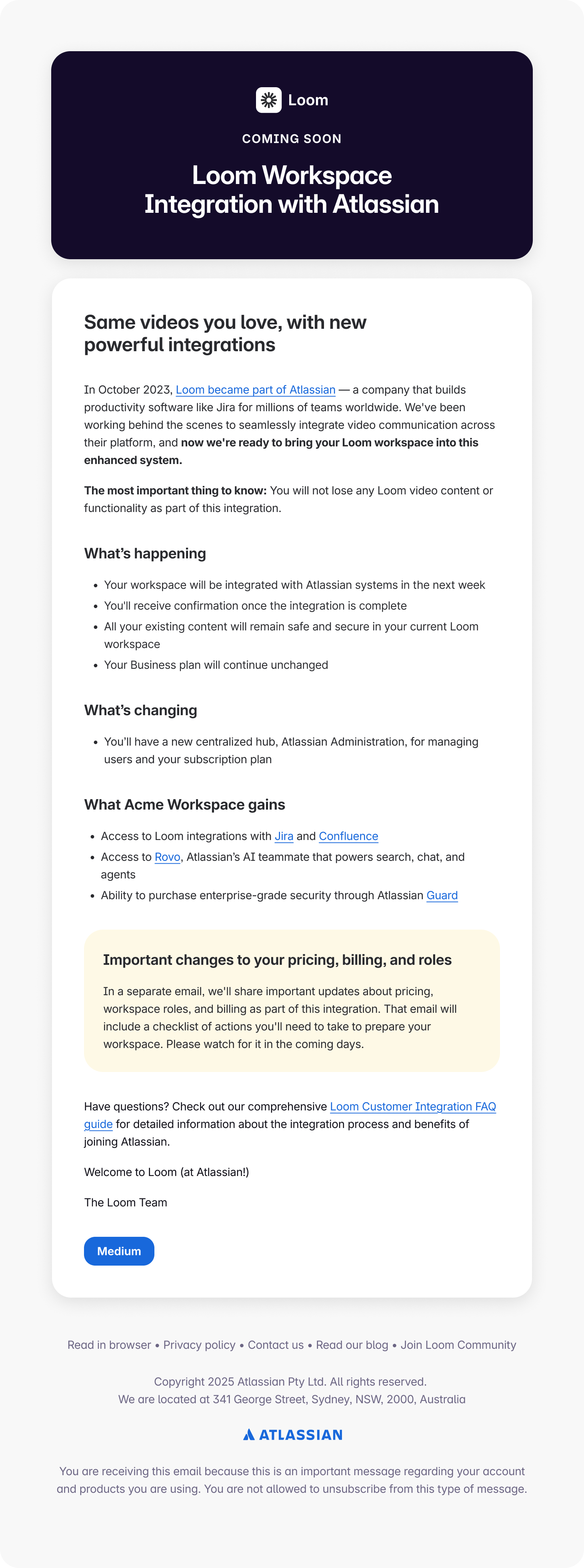
One week out Enough notice to feel prepared, but not enough to build dread. The key message was what was not changing. User research indicated that admins were most worried about their videos remaining safe during the transition.
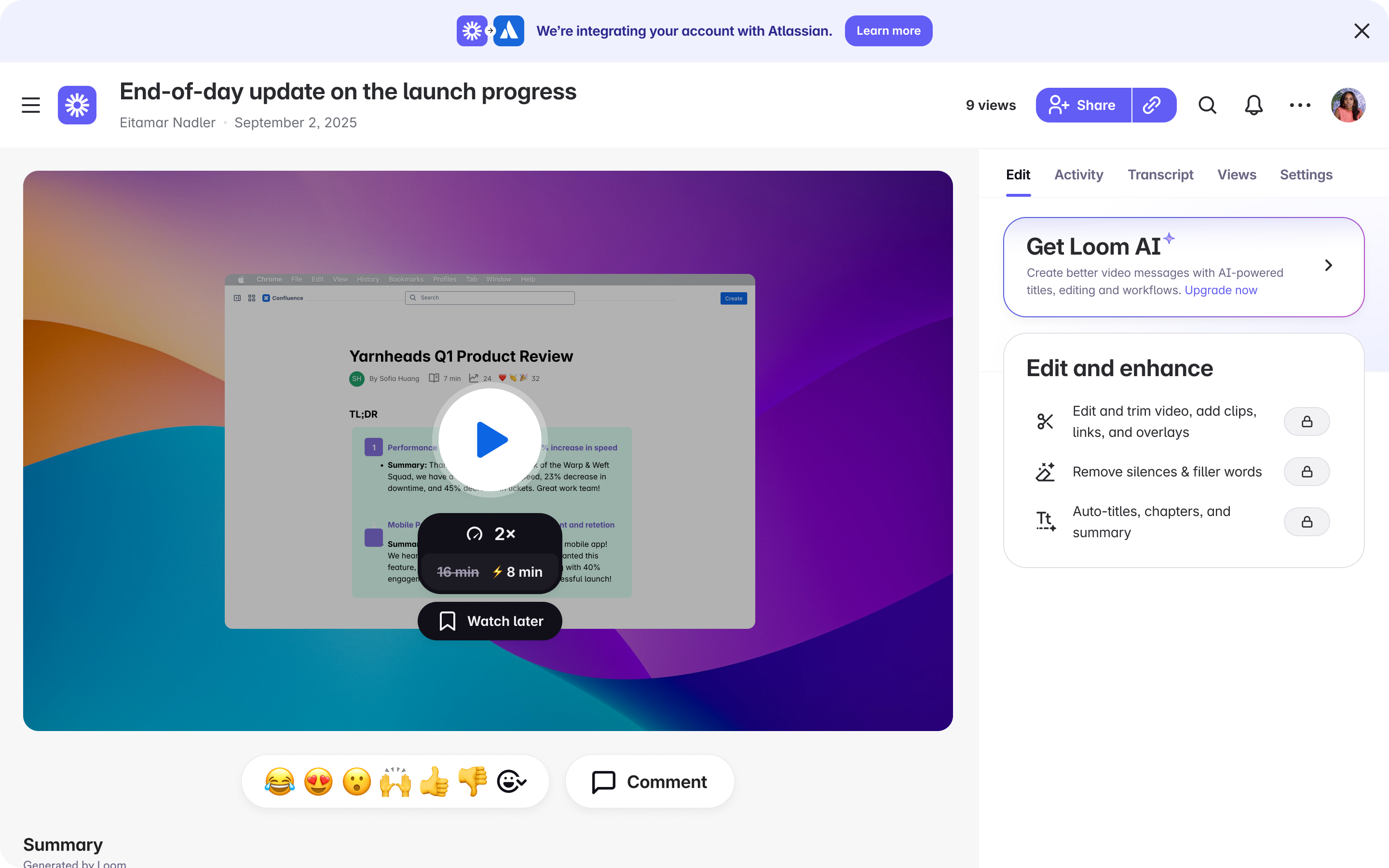
Every day until it happened The banner was a version an admin could not miss, sitting above the product for the weeks their workspace was in line for migration.
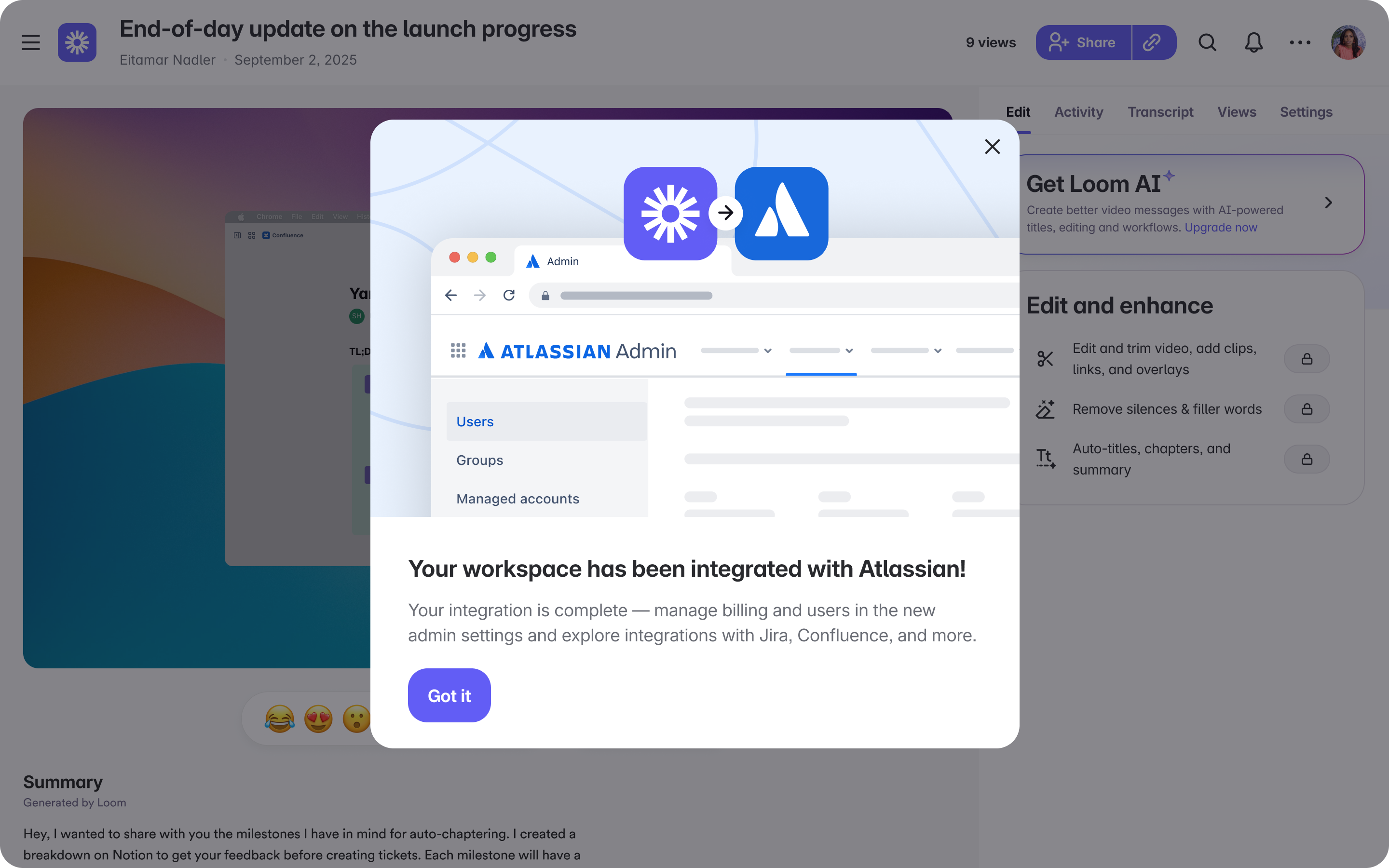
The morning it happened A simple statement that the migration happened, what changed, and one button to acknowledge.
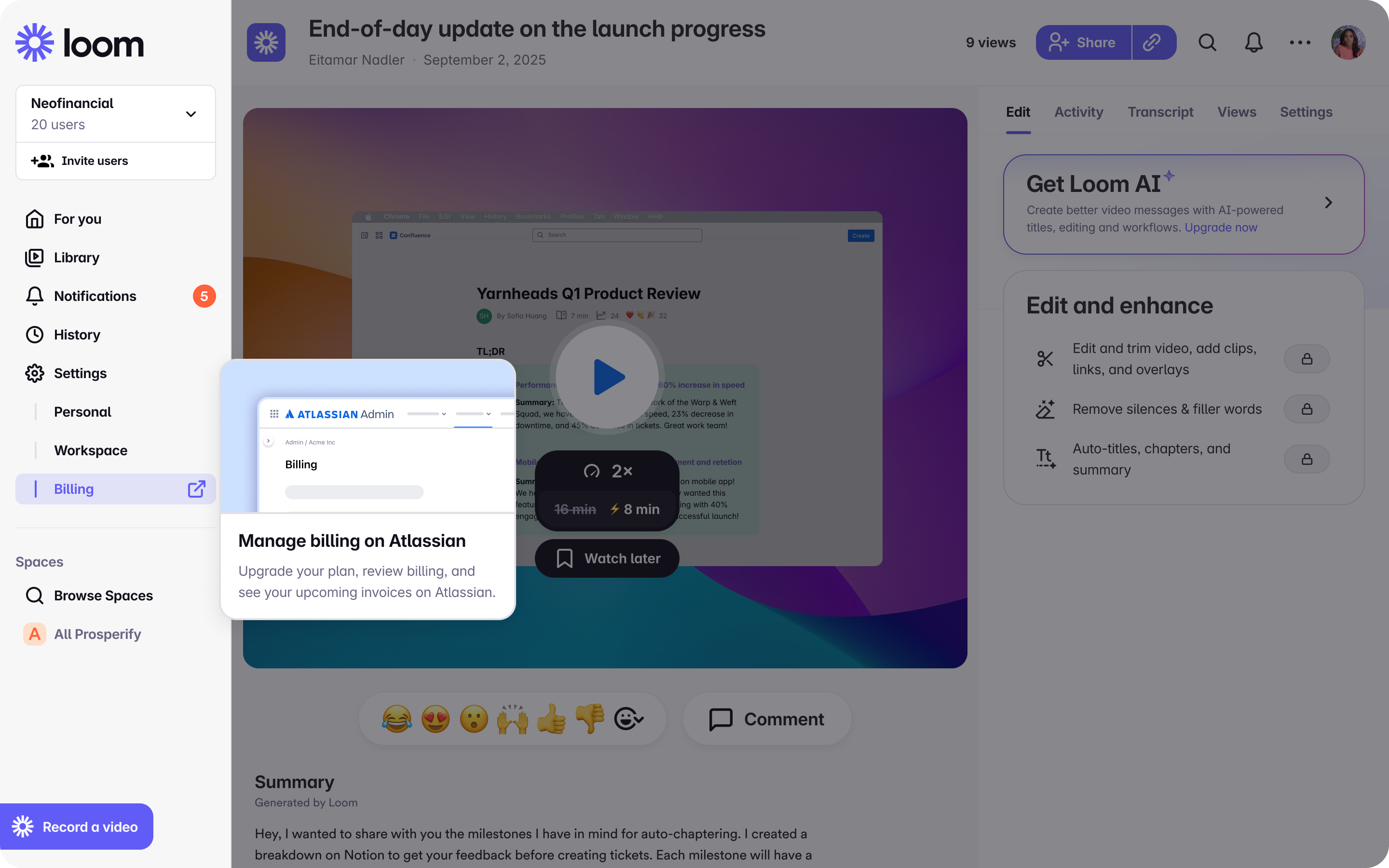
While looking for billing Hovering showed a preview of where you were about to land and a preview of what you could do there, rather than sending you to an unknown destination.
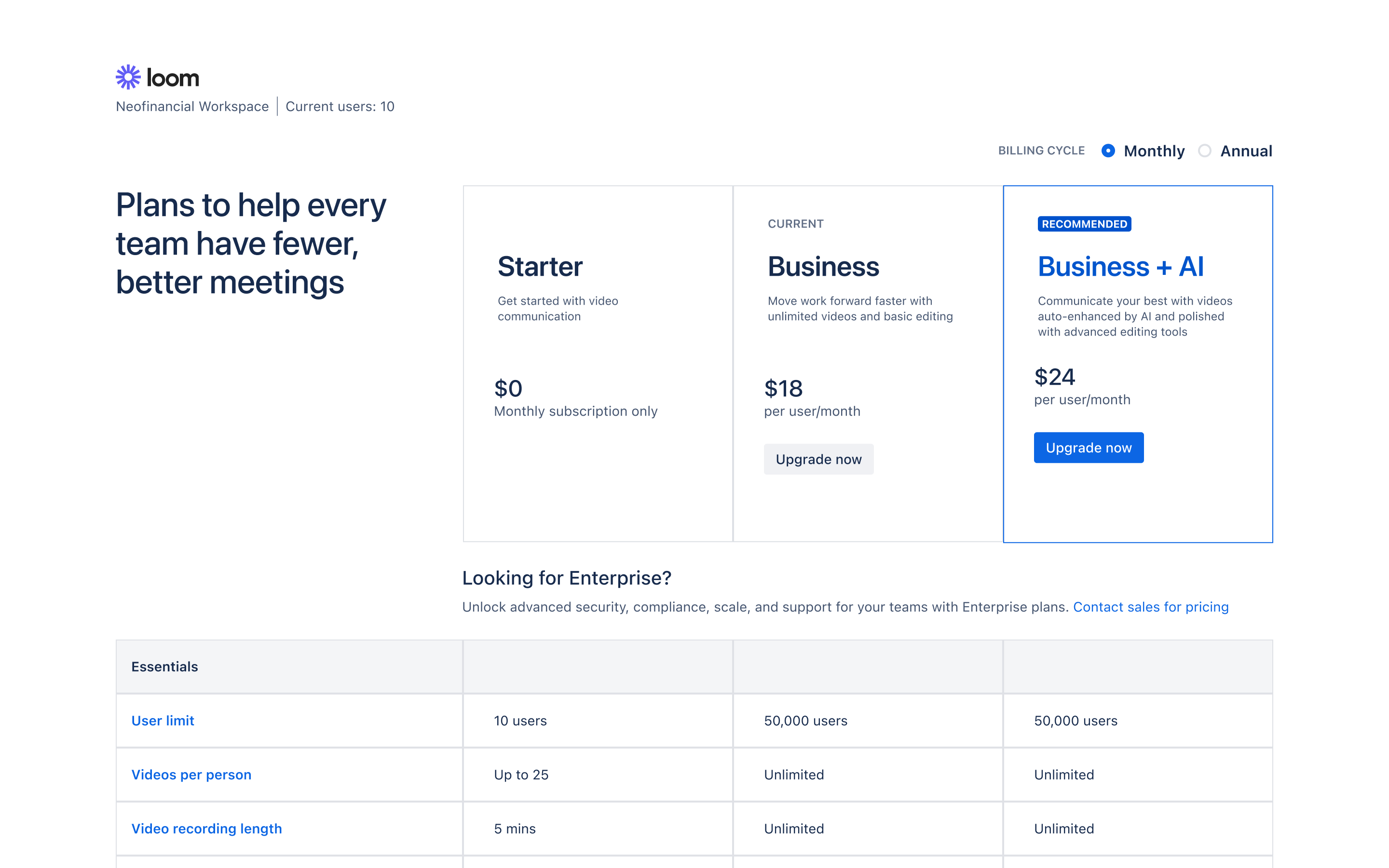
The upgrade decision The new AI tier was marked as recommended and sat at the end of the row. Monthly and annual prices were a toggle. A comparison table sat below the fold.
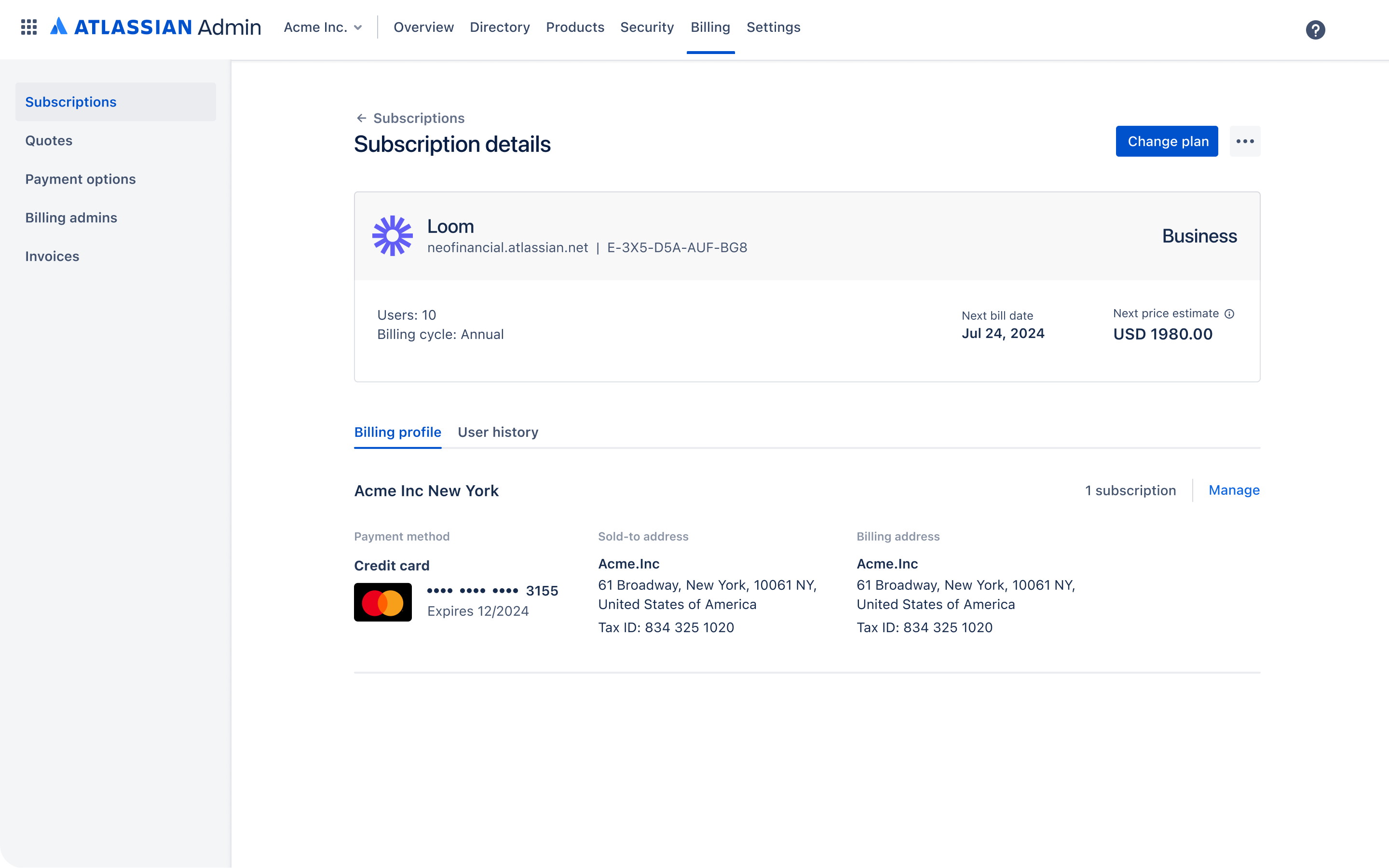
Where billing settings live now A new home rebuilt on Atlassian Commerce Platform and still understandable to someone who had only ever managed a small team Loom plan.
What happened
- Fastest
- integration in Atlassian’s history, launched 24 October 2024
- +38.7%
- over ARR forecast
- 40M
- users moved onto the new platform
“It is really difficult to overstate how complex plugging in an entirely new backend system across our most critical user journeys of sign up, provision, and billing is. Truly the most cross-functional of efforts across Loommates and Atlassian broadly.”
How it got there
The problem
Move 40 million Loom users onto Atlassian without disruption, deprecate 700,000 free roles, and remediate prices for 85% of paying customers. Every existing Loom customer would be impacted by this, and each cohort was high-stakes.
Two admin cultures
Loom admins tend to be senior individual contributors managing small teams. Atlassian admins are IT professionals managing thousands of users in a complex admin hub. We were moving the first group into a system built for the second. Most of the design decisions on this project were guided by this fact, including the settings handoff.
Deciding where to spend
Data Science analyzed the business-critical flows and graded them by churn risk against a benchmark of less than a 5% drop in conversion. That gave us permission to hone our focus:
- Invest in Loom-branded signup, because it sits at the top of the funnel
- Change nothing about the upgrade flows, and instead measure and learn
- Invest in admin and billing, because churn risk was concentrated
Cohorting
We kicked off with a week-long workshop at Atlassian HQ in Sydney with the User Access Admin and Commerce teams. I facilitated at the whiteboard and produced artifacts afterwards. The plan was to start with lower-risk customers to test the migration scripts, sub-cohort by churn risk determined by size of price change and free role reduction, and handle the outliers in snowflake cohorts at the end. Atlassian Commerce’s earlier platform migration had run to more than fifty sub-cohorts, which indicated how granular this needed to get.
Bridging two settings systems
The gnarliest problem was structural rather than visual. Two products with completely different settings information architectures now had to behave like one. I led a group of designers to map which setting lived where, audit the redundancies, design the handoff points between them, build a repeatable pattern for bridging, and argue for the investments in them.
Sequencing the communications
Loom’s free Creator Lite role was deprecating, which meant users had to go through packaging changes as well as a new account system. I worked with product and marketing to map the full sequence: timing, channel, and content for each touchpoint. Design timelines made the sequencing legible by showing the experience as a customer would receive it rather than as a list of sends.
What it took to ship
This project required work beyond the typical scope we consider to be product design:
- Influencing platform teams to adopt changes they had not planned for, including a new cancel flow and per-seat pricing
- Serving as a subject matter expert on Loom’s billing and monetization flows during the commitments process, when the Atlassian Commerce team decided which capabilities they would build for us: trial skipping, mid-cycle true-ups, and scheduled downgrades
- Building processes. There was no process for staying current on Atlassian’s admin and commerce roadmaps, so I set up 1:1s with their designers and monitored their channels to anticipate releases that affected our users.
- Coordinating across Atlassian Admin team and Commerce team divisions in both Sydney and India, Data, and UXR, which is roughly sixteen hours of time zones on a standing basis
What I took from it
Begin small, measure, and iterate
We left real things out of the initial launches: upgrade optimizations, role deprecation tooling, admin onboarding. Getting a baseline first meant the later investments were based on data and more strongly justified.
Compromise was the job
With this many teams and this many moving parts, holding out for the best version of any single flow would have cost the launch. Aligning on shared goals and accepting progress over perfection was a critical part of the success of this project.